Before You Snap That Tablet in Half, Read This: A No-Nonsense Guide to Altering Your Meds Safely
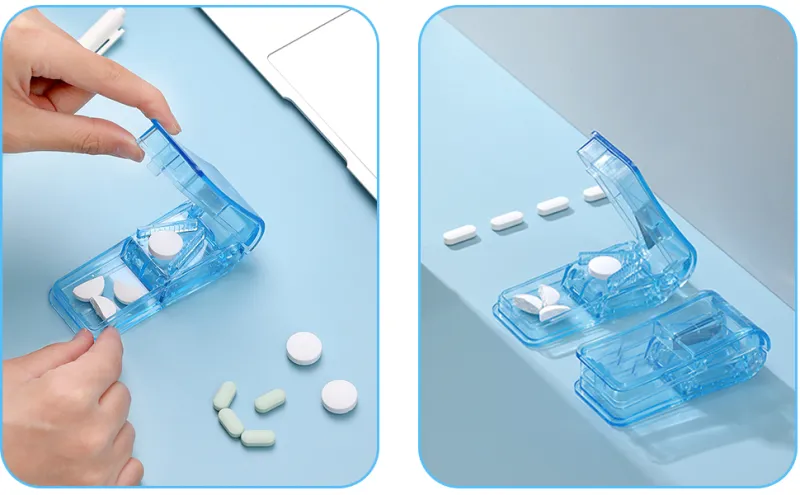
Photo: pill splitter cutting tablet in half on white counter, via m.media-amazon.com
Let's be honest: a lot of us split pills not because we love chemistry, but because we love our bank accounts. A 90-day supply at double the dose, cut in half, can cost about the same as 30 days at the lower dose. That's real money — sometimes $300 or more a year on a single maintenance med.
But here's the part that keeps pharmacists up at night: some pills are designed to be tamper-proof. Split, crush, or chew the wrong one, and instead of a slow, steady release over 24 hours, you get the entire payload dumped into your system at once. That's not a money-saving hack. That's an ambulance ride.
So before you reach for the pill cutter, here's the field guide.
The Green Light: Pills You Can Usually Split
Not every tablet is precious. These categories are often fair game — though you should always confirm with your pharmacist or prescriber first, because manufacturers formulate things differently:
- Immediate-release tablets with a score line. That little groove down the middle isn't decorative. It's an engineering cue that the pill was made to be divided evenly.
- Plain, uncoated tablets. If it's chalky, flat, and boring-looking, chances are it's just compressed powder with no fancy delivery mechanism.
- Common maintenance meds like lisinopril, atorvastatin, and many SSRIs frequently come in split-friendly forms — but check the specific product, because generic versions can vary.
One practical tip: split tablets right before you take them, not a month in advance. Once a tablet is exposed, it starts degrading. A pill organizer full of pre-split halves is a moisture magnet.
The Hard Stop: Pills That Should Never Be Altered
Some medications are basically tiny time-release machines, and breaking one is like smashing the machine. Watch for these red flags:
- Anything with "ER," "XR," "SR," "CR," "XL," or "LA" in the name. Those letters stand for extended-release, sustained-release, or controlled-release. Crack the shell and the whole day's dose hits you at once. In some medications, this can be dangerous enough to be life-threatening.
- Enteric-coated tablets. That smooth, shiny coating exists to protect your stomach — or to protect the drug from your stomach. Chew through it and you can end up with stomach irritation or a med that never makes it to the intestine where it's supposed to dissolve.
- Capsules with tiny beads inside. Some capsules are filled with hundreds of micro-spheres, each coated to release medication on a schedule. Dumping them out destroys the schedule.
- Sublingual and buccal tablets. These are meant to dissolve under your tongue or against your cheek. Swallowing or chewing them changes how your body absorbs the drug — sometimes dramatically.
- Combination or layered tablets. If a pill has two different colors or a visible seam, it may contain two drugs in separate layers, dosed in specific amounts.
The Maybe Column: Cases That Depend
A few situations live in the gray zone:
- Capsules you can open. Some capsules can be sprinkled onto applesauce (great for folks with swallowing trouble), but only if the label or pharmacist says so.
- Chewable formulations. Some meds come in both chewable and standard forms. If splitting isn't an option, ask whether a chewable version exists — it's sometimes the safer workaround.
- Odd-shaped unscored tablets. No score line usually means "don't split me," but not always. This is a five-second question for your pharmacist, and it's free.
Your Quick Reference Cheat Sheet
Print this out and stick it on the fridge:
| Feature on the label or pill | Split/crush? |
|---|---|
| Score line, immediate-release | Usually yes |
| ER, XR, SR, CR, XL, LA | Never |
| Shiny or enteric coating | Never |
| Capsule with beads | Never crush; ask about opening |
| Sublingual (dissolve under tongue) | Never |
| Unscored, odd shape | Ask first |
The Money Math, Done Right
If your med does check out as split-safe, the savings play works like this: ask your prescriber to write the script at double the strength and half the quantity. Same total daily dose, same therapeutic effect, roughly half the out-of-pocket cost on many generic tiers. Some insurers even price certain doses identically — the 20 mg and 40 mg tablets often cost the pharmacy the same, which is the loophole that makes the whole strategy work.
And if you're ordering refills online — which, if you're reading this site, you probably are — the same rule applies. Whether your pills come from a corner pharmacy counter or your mailbox, the formulation rules don't change. Check the imprint, check the label, and when in doubt, send a quick message to a pharmacist before you make the first cut.
Splitting pills is one of the smartest, quietest ways to cut your med budget. Doing it to the wrong tablet is one of the fastest ways to undo all that savings — and then some. Thirty seconds of checking beats a trip to the ER every single time.